Google Ads Business Verification: Business Operations Review Checklist
Explain who advertises, sells, delivers, and takes payment. Prepare relationship evidence and answer the specific business operations questions.
Business operations verification needs a clear account of how the advertised business works. Explain the offer, the organisations involved, and each organisation's responsibilities. Support the explanation with records that match the actual arrangement.
Google's business operations troubleshooting guide identifies several problem areas. These include inconsistent information, unclear relationships, unidentified providers, and missing identity or licensing evidence. Use the reason in your notice to focus the investigation.
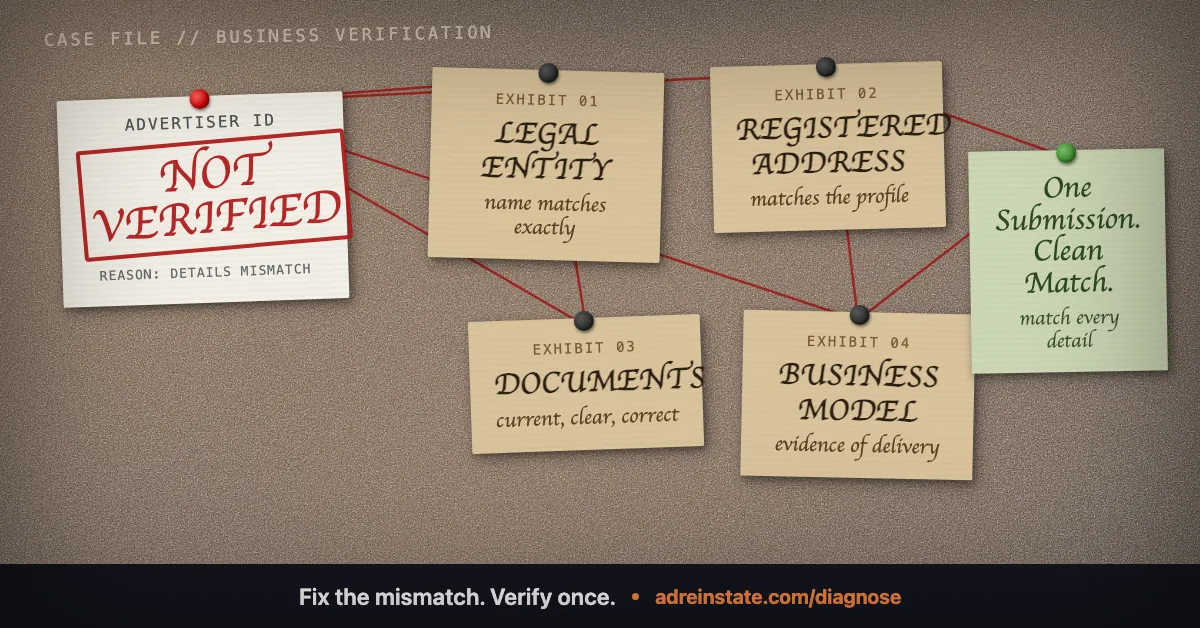
Describe the business in one plain paragraph
Start with a draft that answers five questions:
- What can a customer buy or request?
- Which organisation enters the agreement with the customer?
- Who supplies the goods or performs the service?
- Who collects payment and handles complaints?
- Who owns or manages the advertising account and website?
Use specific roles. “We provide solutions through trusted partners” leaves the reader guessing. “We introduce customers to independent installers, who quote and bill customers directly” explains a particular model.
Check that the paragraph describes today's operation. A copied company introduction may describe an old product or a business model that has changed.
Map each organisation to its evidence
Build a role table before answering the form. This is our preparation method, not a required Google template.
| Role | Question to resolve | Possible record to inspect |
|---|---|---|
| Advertised business | Who is responsible for the offer? | Company record and customer terms. |
| Supplier or service provider | Who fulfils the customer's order? | Supply agreement or service contract. |
| Agency | What work can it perform for the advertiser? | Current campaign management agreement. |
| Website operator | Who controls the advertised domain? | Ownership or authorised management records. |
| Billing organisation | Who pays for advertising and why? | Relevant billing arrangement. |
The examples above help you locate evidence. They do not mean that every task requires every document. Submit the evidence requested for your actual relationships.
Where relationship evidence is required, Google's official guidance describes options such as agreements, explanatory letters, and other valid records. Check its document instructions before uploading files.
Compare the explanation with the customer journey
Read the landing page as a customer who knows nothing about the business. Follow the enquiry, purchase, or booking process.
- Identify the company named before the customer submits details.
- Check who the terms describe as the contracting party.
- Compare the promised service with the provider's actual responsibility.
- Check whether contact details reach the advertised business or a separate operator.
- Record claims about official status, licences, partners, or brand authorisation.
For each claim, identify the record that supports it. An agency can manage an advertiser's account without owning its service licence. A reseller can sell an item without being the manufacturer. Describe those differences accurately.
Do not rewrite every organisation name into one name. Resolve contradictions while preserving the real relationships. If a recent rebrand causes confusion, use our business change evidence guide.
Fictional worked example: a lead-generation business
This example is fictional. ClearHome Leads Ltd runs a quote-request website for home insulation. Northfield Media manages its advertising. Independent installers contact customers and issue their own quotes.
The website currently says “our installation teams”. That wording does not explain the actual arrangement. The owner prepares this record:
| Party | Actual role | Evidence and correction |
|---|---|---|
| ClearHome Leads Ltd | Operates the website and introduces enquiries to installers. | Company record, customer explanation, and accurate enquiry form text. |
| Northfield Media | Manages campaigns for ClearHome Leads. | Agency agreement and account access record. |
| Participating installer | Assesses the property, quotes, performs work, and bills the customer. | Partner agreement and relevant provider records. |
| Customer | Requests contact from a provider. | Published explanation of who receives the enquiry and what happens next. |
The owner replaces the installation-team claim with an accurate description of the introduction service. The form answers then name each party consistently with the records.
The owner still checks the policies that apply to the advertised service and target locations. This evidence map does not establish policy eligibility for every lead-generation arrangement. The example ends with a documented explanation, without a claimed approval.
Investigate a rejection one reason at a time
Create a small comparison table using the rejection, your submitted answer, and the supporting document. Identify whether the issue concerns identity, role, website wording, or missing evidence.
If the notice concerns the end provider, adding another company registration certificate may leave the question unanswered. Explain who performs the service and show the relevant relationship.
If the notice concerns inconsistent identity details, return to the advertiser verification guide. If account controls prevent a correction, record the restriction and consult the blocked verification guide.
Agencies with several clients can also use our manager account evidence guide. Keep each client's identity and case records separate during preparation.
Our verification support service helps organise the model explanation and requested evidence. Start a diagnosis if you need help identifying the unanswered question.
Frequently asked questions
Is business operations verification the same as identity verification?
They address different questions. An identity document identifies a person or organisation. A business operations explanation describes the offer, delivery model, and relationships behind the advertising.
Should an agency describe itself as the service provider?
Only if it actually provides the advertised service. Distinguish campaign management from selling, fulfilment, and customer support. Explain the agency's real role.
Can a lead-generation business use this checklist?
Yes, to organise its facts and relationships. The checklist does not establish that its particular offer or advertising model meets every policy.
What if a supplier will not share a contract?
Check the evidence options in the actual task and official guidance. Explain what exists and what is missing. Do not invent an agreement or claim an undocumented authorisation.
Still narrowing down what triggered your suspension? Read the plain answers to common questions , or see how our reinstatement services map to each violation type.
Not sure which suspension you have?
Start with a free diagnosis. We identify the likely trigger and tell you honestly whether we can fix it, before you spend anything.