How to Appeal a Google Ads Suspension: Evidence and Worked Example
Identify the notice, record your findings, and explain completed fixes. Use an evidence index and a factual appeal structure.
Start with the exact suspension notice. A useful appeal connects that notice to specific facts, completed corrections, and supporting records. The wording cannot replace a policy investigation.
Google's suspension overview explains the available appeal process. Keep one appeal pending at a time. Some suspended advertisers must complete verification before they can appeal. Do not create another account to resume suspended advertising.
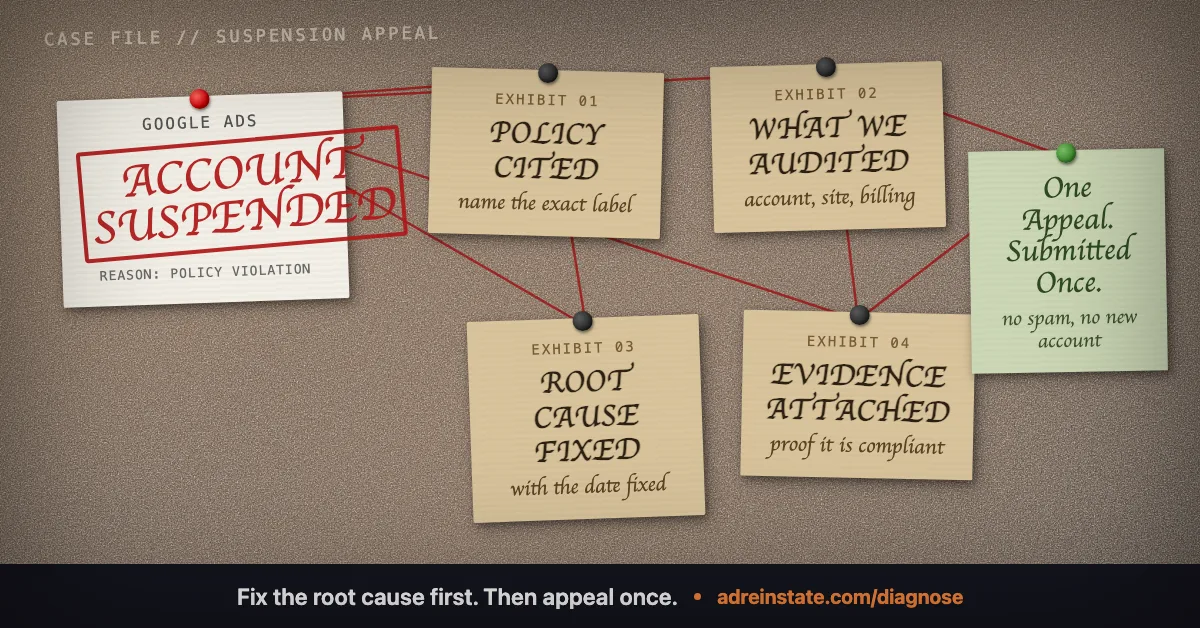
Choose the route that matches the problem
Save the account number, notice, date, policy link, and previous case references. Copy the exact status instead of summarising everything as a ban.
| What you find | Next investigation |
|---|---|
| A policy suspension | Read the named policy and compare it with the advertised offer, website, and account history. |
| A verification requirement | Identify the unfinished task. Use the blocked verification guide if it prevents an appeal. |
| Unauthorised access or spending | Follow Google's official security reporting guidance. Use our hacked account guide to organise the chronology. |
| A billing notice | Compare the notice with the payments profile, transaction history, and requested verification. |
| A Merchant Center restriction | Open the issue in Merchant Center and use its separate review process. |
Several rows can apply to one business. Make a separate record for each issue so one completed task does not hide another restriction.
Build an evidence index before writing
Download the appeal evidence index CSV. Open it in a spreadsheet and delete the fictional sample row before adding your records.
The file uses eight fields: issue, policy, observation, action, status, date, evidence, and owner. It is a preparation tool, not an official Google form.
- Describe one observed problem per row. Include the page or account field where you found it.
- Link the relevant policy section. Explain the connection in your own words.
- Record the action and its owner. Use a precise date rather than “recently”.
- Mark the action completed, proposed, blocked, or awaiting verification.
- Point to evidence that another person can inspect. Keep the original record as well as your summary.
Capture the live result after each correction. A screenshot from a draft page does not establish what a customer can see. Check the same URL, device, and location used in your earlier record.
Keep sensitive files in a controlled folder. Submit documents through the official route when requested. Never publish identity documents or customer records as public evidence links.
Separate what you know from what you suspect
A notice can name a broad policy without identifying one exact cause. Your investigation should preserve that uncertainty.
“The contact page used an old company name” is an observation. “This name caused the suspension” is an inference unless Google confirms it. Explain the observation and correction without presenting the inference as a fact.
Check each finding against the actual policy. For example, Google's misleading representation policy addresses inaccurate identity or affiliation claims. That reference helps explain a specific claim correction. It does not establish the hidden reason for every suspension.
Fictional worked example: reseller affiliation wording
This example is fictional. Northbridge Parts Ltd sells replacement components under the brand PumpBench. It receives a suspension notice citing Misrepresentation.
The owner finds “official manufacturer support” on a landing page. The company has no evidence supporting that affiliation. An existing ad contains similar wording, but the suspended account prevents the owner from changing it.
| Finding | Action and status | Evidence |
|---|---|---|
| Landing page claims manufacturer affiliation. | Completed on 8 September: replace the claim with an accurate description of the independent reseller. | Dated page capture and published URL. |
| Ad contains the same affiliation claim. | Blocked: record the current ad. Propose accurate replacement wording. | Ad identifier, current text, and screenshot of the editing restriction. |
| Trading brand is not explained on the company page. | Completed on 8 September: explain which legal company operates PumpBench. | Company page and registration record. |
The owner can now explain the changes without claiming that the ad is already corrected. The example ends with an evidence package. It does not describe a reinstatement outcome.
Write a short appeal that follows the evidence
Adapt this structure to the questions in the actual form. It is not a script that guarantees approval.
- Identify the account and business. Give the account number, legal operator, website, and relevant case reference.
- Name the notice. Use the policy label shown in the account.
- Explain the investigation. State what you checked and what you found.
- Describe completed actions. Include dates and direct evidence references.
- List remaining restrictions. Distinguish locked changes from completed work.
- Request review. Ask Google to review the evidence and identify any required next step.
For the fictional reseller, one paragraph could read:
We found unsupported manufacturer affiliation wording on the landing page and in ad A17. We corrected the website on 8 September. Evidence E1 shows the published page. Ad A17 remains unchanged because account editing is restricted. Evidence E2 records that restriction and our proposed replacement wording. Please review these records and advise on the required next step.
Copy the submitted answers into your case folder. Save the confirmation and subsequent response. If Google rejects the appeal, compare the response with your evidence before deciding what remains unresolved.
If you need help organising the investigation, review our Google Ads suspension audit or start a suspension diagnosis.
Frequently asked questions
Should I admit a violation when I do not know the cause?
No. State the notice, your observations, and any confirmed corrections. Separate evidence from a possible explanation. Do not invent a cause or admit conduct that did not occur.
What if suspension prevents me from editing an ad?
Record the locked field and its current value. Explain the proposed correction separately from completed website changes. Ask for the appropriate next step through the account's available appeal or support route.
Can I use this appeal structure for Merchant Center?
Use the evidence method, but follow Merchant Center's own issue and review process. A Google Ads appeal does not replace a Merchant Center review.
What should I do after an appeal is rejected?
Read the response and compare it with the submitted evidence. Identify an unresolved issue, factual error, or relevant new evidence before using any further route offered.
Still narrowing down what triggered your suspension? Read the plain answers to common questions , or see how our reinstatement services map to each violation type.
Not sure which suspension you have?
Start with a free diagnosis. We identify the likely trigger and tell you honestly whether we can fix it, before you spend anything.