Google Ads suspended for Circumventing Systems: what it means and how to fix it
Circumventing Systems is the most common suspension, and most of the businesses that get it never tried to trick anyone. Here is what the label means and how to clear it.
Circumventing Systems is the suspension reason Google reaches for when it believes an advertiser is trying to bypass or trick its ad review process. It is the most common suspension type, and that is exactly why it is so misunderstood. Most accounts that receive it were not trying to trick anyone. They tripped a technical signal that looks, to an automated system, like evasion.
The label tells you almost nothing about the actual trigger. That is by design. If Google spelled out the precise signal, bad actors would fix only that one thing. So the burden falls on you to investigate broadly and prove the account is clean.
What Circumventing Systems actually means
The policy covers any behaviour that appears to dodge Google's review. In practice it breaks into a few patterns, and knowing which one applies to you changes everything about how you respond.
Cloaking
Cloaking means Google's crawler sees different content than your real visitors do. The malicious version is showing a clean page to Google and a prohibited one to users. The innocent version is far more common and includes:
- A site migration where DNS or CDN caching served Google an old version while users saw the new one.
- Cloudflare or other CDN caching that returned stale pages to the crawler.
- Geolocation logic that showed Google's US based crawler something different from your target market.
- A or B testing tools that served the crawler a different variant.
- Pop ups or interstitials that blocked the crawler from reading the landing page.
- Redirect chains where the final URL differed from the ad URL.
Multiple account abuse
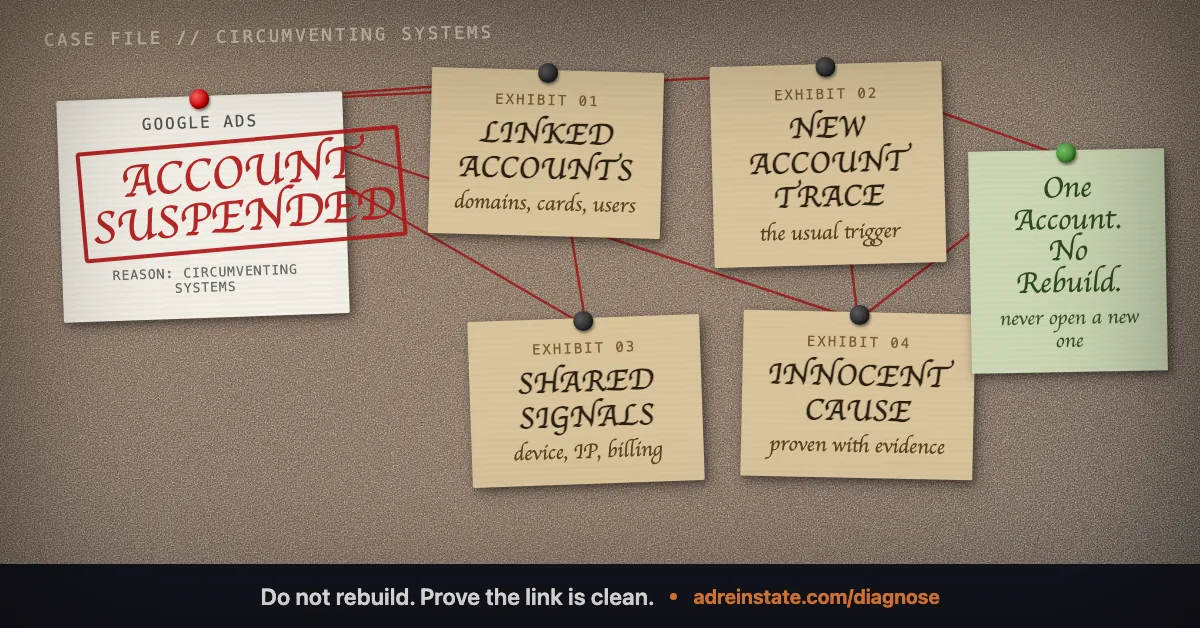
Creating a new account after a suspension is itself a violation, even when it feels like a fresh start. This often happens innocently. A previous agency may have opened an account years ago that nobody remembers. A rebrand may have spawned a second account while the first was still suspended. Google reads all of it as one entity trying to re enter the system.
Cross account patterns
If you run similar campaigns for similar businesses, or manage several clients under one manager account, a single violation can pull the whole structure into scrutiny. Google's systems look for one operator wearing many hats.
Trigger, innocent cause, and the evidence that clears it
Match your situation to the most likely trigger before you write anything. Each row points to the proof a reviewer needs to see.
| Signal Google saw | Common innocent cause | Evidence that reverses it |
|---|---|---|
| Crawler and user see different pages | Stale CDN cache or A/B test variant served to the crawler | Side-by-side render of the page as Google fetches it and as a user sees it, plus the cache purge timestamp |
| Redirect mismatch | Final landing URL differs from the ad URL after a chain of hops | A mapped redirect chain from ad URL to final page with the offending hop removed |
| Geo or device cloaking | Geolocation logic showing the US-based crawler a different market | Documentation of the geo rule and proof the crawler now sees the same content as the target market |
| Multiple or re-created accounts | A forgotten older account opened by a previous team or agency | An inventory of every linked account with old or unused ones properly closed and disclosed |
| Compromised site producing evasion signals | Injected malicious scripts the owner never saw | A clean security scan and a record of what was removed and when |
Why legitimate businesses get flagged
The honest answer is that the detection is probabilistic. A geolocation redirect, a slow DNS propagation, or a forgotten old account are all normal events that happen to resemble evasion. You are not being accused of fraud. You are being asked to prove that the resemblance was a coincidence and that it no longer exists.
Fix it before you appeal
An appeal without a fix is noise, and Google remembers the noise. Work through the technical evidence first, then file. The core checklist:
- Confirm your landing page renders identically for the crawler and for users. Fetch the page as Google and compare it to what a real visitor sees.
- Clear and verify your CDN cache so no stale version is being served.
- Map every redirect from the ad URL to the final page and remove any mismatch.
- Run a security scan and keep the clean report. Compromised sites can also produce cloaking signals.
- Inventory every Google Ads account connected to your domain, payment method, or team. Disclose and properly close any you no longer use.
- Document dates. If a migration on a specific date caused the issue, say so precisely.
What a working appeal looks like
Acknowledge the policy that was cited without admitting to wrongdoing you did not commit. Describe what you audited. Explain what you found and why it likely triggered the system. List the corrective actions with dates. Attach the evidence. Then make a clear, professional reinstatement request. Avoid emotional language, avoid blaming Google, and never submit the same appeal twice without new information.
Circumventing Systems is one of the more fixable suspensions once you identify the exact trigger. The work is in the investigation, not the wording. Google's own account suspensions overview confirms the policy exists to stop attempts to interfere with its review systems, which is why proving a clean, consistent setup matters more than argument.
This violation usually maps to our PolicyShield Standard service. If you want the trigger found for you first, our free suspension diagnosis names the likely cause and tells you whether the case is viable before you spend anything. For the full evidence-first workflow, see how to appeal a Google Ads suspension, and start from the main guide on what to do when your Google Ads account is suspended. No one, including us, can guarantee Google's decision.
Frequently asked questions
What does a Circumventing Systems suspension mean?
It is the reason Google cites when it believes an advertiser is trying to bypass or trick its ad review process. The label is deliberately vague, so the work is identifying the exact technical signal that triggered it, such as cloaking, a stale CDN cache, a redirect mismatch, or a forgotten old account.
Why do legitimate businesses get flagged for Circumventing Systems?
The detection is probabilistic. A geolocation redirect, slow DNS propagation, or a forgotten old account are normal events that happen to resemble evasion. You are being asked to prove the resemblance was a coincidence and no longer exists.
How do I fix a Circumventing Systems suspension before appealing?
Confirm the landing page renders identically for the crawler and for users, clear the CDN cache, map every redirect, run a security scan, and inventory every account tied to your domain or payment method. Fix first, then appeal with the evidence.
Can I create a new Google Ads account after a Circumventing Systems suspension?
No. Opening a fresh account is itself a Circumventing Systems violation and is one of the fastest ways to make the original case worse. Google connects accounts through domains, payment methods, users, and business details, so a new account is usually detected and suspended too. Fix the existing account and appeal it instead.
Still narrowing down what triggered your suspension? Read the plain answers to common questions , or see how our reinstatement services map to each violation type.
Not sure which suspension you have?
Start with a free diagnosis. We identify the likely trigger and tell you honestly whether we can fix it, before you spend anything.