Google Ads Cloaking: What It Means and How False Positives Happen
Cloaking means Google's systems see different content than your users do. Most cloaking suspensions for real businesses are false positives from caches, redirects, geo logic, or a hacked site.
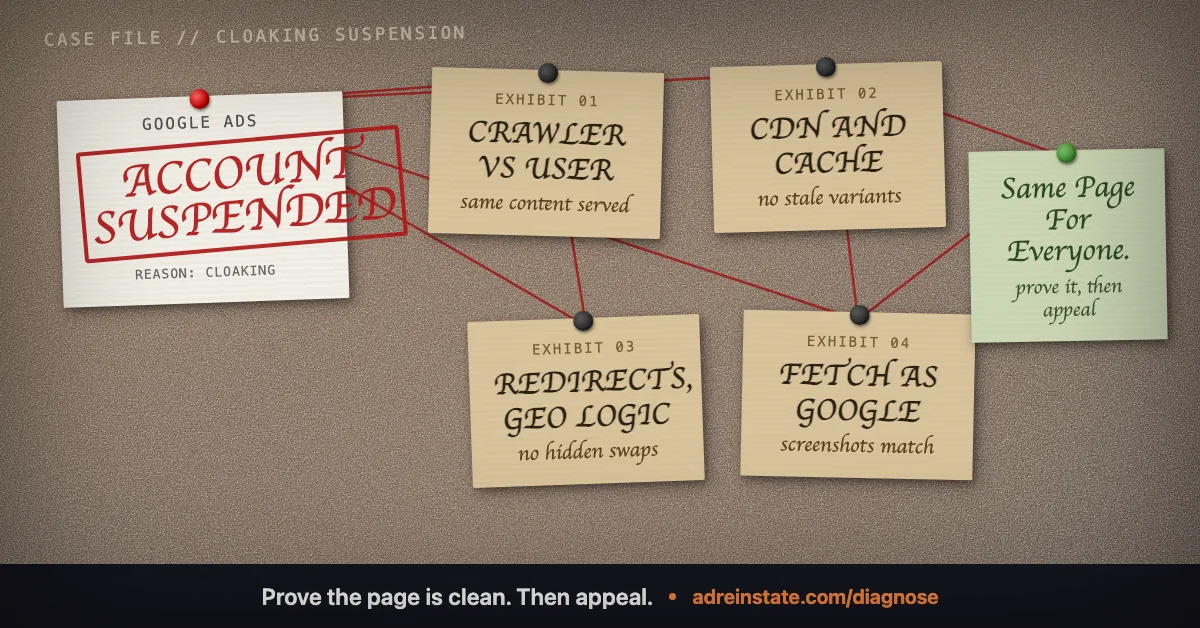
Direct answer: In Google Ads, cloaking means Google's systems see different content than your users see. For legitimate businesses it is usually a false positive caused by a CDN cache, a redirect, geo logic, A/B testing, blocked crawlers, or a compromised site. The fix is to make the crawler and real users see identical content, then prove it. Cloaking is enforced as a Circumventing Systems violation.
Cloaking is one of the most technical suspension triggers, and one of the most misunderstood, because the advertiser often genuinely did nothing deceptive. Google's account suspensions overview treats attempts to interfere with its review as serious, and cloaking falls squarely under the Circumventing Systems policy. The broader recovery path is in our guide on what to do when your Google Ads account is suspended.
Malicious cloaking versus accidental crawler mismatch
Malicious cloaking deliberately shows Google a clean, compliant page while serving users something prohibited. That is what the policy exists to stop. The far more common version for real businesses is accidental: a technical setup that happens to serve the crawler different content than visitors. Same signal, very different cause, and the appeal has to make that distinction with evidence.
The technical false-positive causes
| Cause | How it creates a mismatch |
|---|---|
| CDN or cache | A stale cached version is served to the crawler while users get the updated page. |
| Geo or IP logic | Region-based content shows Google's crawler a different market than your users. |
| A/B testing | Testing tools serve the crawler a different variant than real visitors. |
| JavaScript rendering | Content that only loads via JS may not render the same way for the crawler. |
| Redirect chains | The final landing page differs from the ad URL after a series of hops. |
| WAF or firewall blocks | Security rules block or challenge the crawler, so it sees an error or a stripped page. |
| Compromised site | Injected scripts or redirects show Google different content than users. |
How to test for cloaking
- Fetch as Google. Render the page as the crawler and capture what it returns.
- Compare the HTML. Put the crawler's version next to a normal visit and look for differences.
- Crawl the redirect chain. Map every hop from the ad URL to the final page and find any divergence.
- Screenshot variants. Capture the page across regions and devices to expose geo or device logic.
- Review logs. Check server logs for what was actually served to Google's user agent and IP ranges.
Fix checklist
- Clear and verify the CDN cache so no stale version reaches the crawler.
- Make sure geo and A/B logic never serves Google a different variant than the target market sees.
- Collapse redirect chains so the ad URL and final page match.
- Allow Google's crawler through any firewall or bot-protection rules.
- If the site was compromised, remove the injected code and confirm with a clean scan, as covered in our malware suspension guide.
Appeal evidence
Once the page is consistent, the appeal needs proof: side-by-side renders for the crawler and users, a mapped redirect chain with the offending hop removed, a cache purge timestamp, and a clean security scan where relevant. Then follow the structure in how to appeal a Google Ads suspension. Cloaking maps to our PolicyShield Complex service, while non-cloaking Circumventing Systems false positives map to PolicyShield Standard. An AdReinstate Audit can find the exact mismatch first. Eligible Google Ads policy services carry a 100% money-back guarantee if we do not reinstate the account within 60 days, subject to terms, and no one can guarantee Google's decision. A free diagnosis is the quickest way to confirm cloaking is the real trigger.
Frequently asked questions
What is cloaking in Google Ads?
Cloaking means Google's systems see different content than your real visitors see. Malicious cloaking deliberately shows the crawler a clean page and users a prohibited one. It is treated as a Circumventing Systems violation because it tries to evade ad review.
What causes a cloaking false positive?
Innocent technical setups: a CDN or cache serving a stale page to the crawler, geo or IP logic showing different content by region, A/B testing variants, heavy JavaScript rendering, redirect chains, a firewall blocking the crawler, or a compromised site injecting code the owner never sees.
How do I test whether my landing page looks cloaked to Google?
Fetch the page as Google and compare it to what a normal visitor sees, crawl the full redirect chain from the ad URL to the final page, screenshot the page across regions and devices, and review server logs for what was served to the crawler.
How do I prove my landing page is clean?
Provide side-by-side renders showing the crawler and users see identical content, a mapped redirect chain with any mismatch removed, a cache purge timestamp, and a clean security scan if a compromise was involved.
Can a hacked website cause a cloaking suspension?
Yes. A compromised site can inject scripts or redirects that show Google different content than users, producing a cloaking signal the owner never intended. Cleaning the site and proving it is clean is part of the fix.
Still narrowing down what triggered your suspension? Read the plain answers to common questions , or see how our reinstatement services map to each violation type.
Not sure which suspension you have?
Start with a free diagnosis. We identify the likely trigger and tell you honestly whether we can fix it, before you spend anything.