Google Ads Suspended for No Reason? Why False Positives Happen
It rarely is no reason. An automated system almost always saw a signal, even when the signal was wrong. Here are the false-positive patterns and how to find the one that hit you.
Direct answer: A Google Ads account almost never gets suspended for no reason. What usually happened is that an automated system detected a risk signal, such as a linked account, a billing mismatch, a crawler-versus-user content difference, a failed verification, or a suspicious website pattern, and the signal was wrong. The reason feels invisible because Google names a category, not the trigger. Find the signal, fix it, then appeal with evidence.
This is one of the most frustrating ways to lose an account, because everything looks fine from where you sit. But the system is not reading your intent, it is matching patterns. Google's account suspensions overview describes the categories; it does not reveal the exact signal, which is exactly why the situation reads as 'no reason'. The broader recovery path is in our guide on what to do when your Google Ads account is suspended.
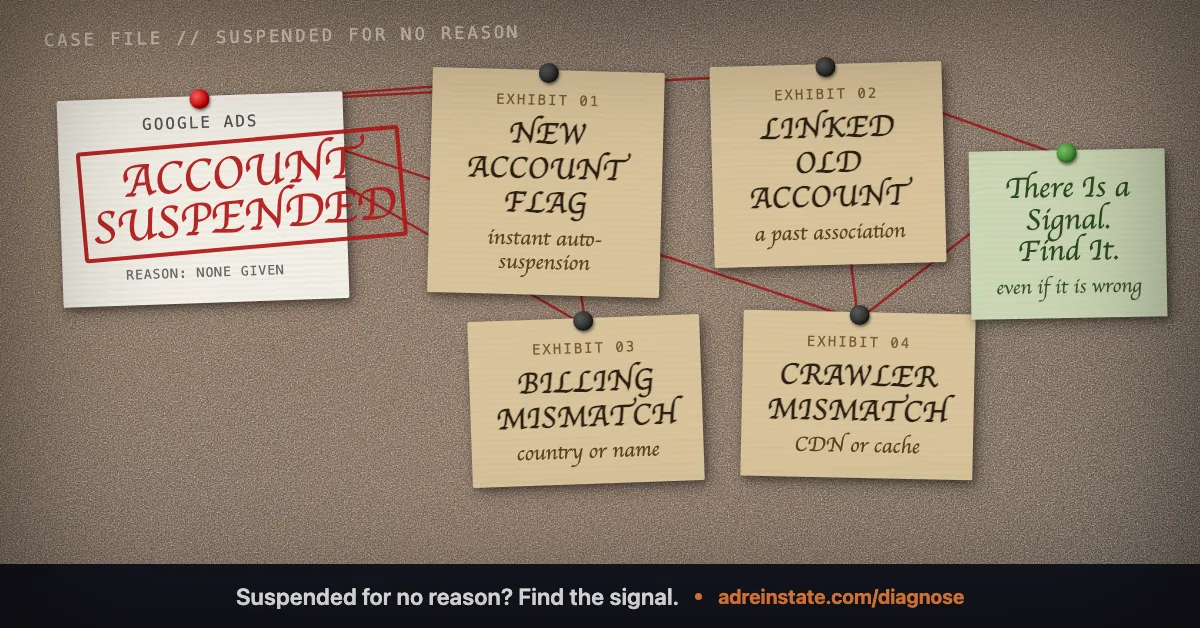
The common false-positive patterns
Almost every 'no reason' suspension maps to one of these. Read them as a shortlist of where to look:
| Pattern | What the system saw |
|---|---|
| New account, instant suspension | The new account linked to a prior suspended one through a domain, card, user, or device. |
| CDN or cache mismatch | The crawler was served a stale or different version of a page than real visitors saw. |
| Old account association | A forgotten account opened years ago by a previous team or agency tied back to you. |
| Billing country mismatch | A card issued in one country against a billing address in another looked like a fraud risk. |
| Verification name mismatch | The legal name, entity, or address did not match across the account and documents. |
| Linked Merchant Center issue | A Misrepresentation or policy problem in a connected Merchant Center account spilled over. |
How to find the signal
Work through the five areas the system watches, in order, until something does not line up:
- The label. Read the notice and note the exact policy category. It narrows the search.
- The website. Fetch your landing pages as Google and compare them to what a visitor sees. Look for stale caches, redirects, geo logic, and injected scripts. The mechanics are covered in our Circumventing Systems guide.
- Billing. Check that the payment method, billing country, and business details are consistent. See suspicious payment suspensions for international advertisers.
- Verification. Confirm the legal name and address match everywhere, per the advertiser verification guide.
- Linked accounts. Inventory every Google Ads, manager, Merchant Center, and Business Profile account tied to your domain, payment method, team, or devices.
Why a rushed appeal hurts
The instinct is to appeal immediately and explain that you did nothing wrong. That almost always backfires. Reviewers compare the live account against the cited policy, so an appeal filed before you have found and fixed the signal reads as 'nothing changed', and a denial follows. Worse, repeated identical appeals can exhaust your options. The order is fixed: diagnose first, fix before appeal, then appeal with evidence.
Self-appeal or forensic audit?
If you found a single, obvious signal and fixed it cleanly, a careful self-appeal is reasonable. If the cause is invisible, if you have already been denied, or if the likely trigger is a technical mismatch or account linkage you cannot trace, a forensic audit is the safer path. Our AdReinstate Audit documents the likely trigger and a prioritised fix plan, and a free diagnosis will tell you which group you are in before you spend anything. No one can guarantee Google's decision, so the honest first step is always finding the real reason.
Frequently asked questions
Why was my Google Ads account suspended for no reason?
Almost always there was a reason, just not one you can see. An automated system detected a risk signal such as a linked account, a billing mismatch, a crawler-versus-user content difference, a failed verification, or a website pattern that resembles abuse. The label is vague on purpose, so the work is finding the actual signal rather than concluding there was none.
Can a brand new Google Ads account be suspended immediately?
Yes. A new account can be suspended on creation or first spend if it links to a previously suspended account through a domain, payment method, user, or device, or if the website or billing profile matches a known risk pattern. This is one of the most common 'no reason' suspensions.
How do I find the real reason for a suspension?
Audit broadly: the policy label, the website as Google's crawler sees it, the billing and payments profile, verification status, and every linked account. The trigger usually sits in one of those five areas, and a structured diagnosis is faster than guessing.
Should I appeal straight away if I cannot see a reason?
No. Appealing before you have found and fixed the signal usually leads to a denial, and each denial makes the next attempt harder. Diagnose first, fix the root cause, then appeal with evidence.
When should I get a forensic audit instead of self-appealing?
When you genuinely cannot identify the signal, when an appeal has already been denied, or when the likely cause is technical or account-linkage evidence you are not equipped to gather. A free diagnosis will tell you the likely trigger and whether the case is viable first.
Still narrowing down what triggered your suspension? Read the plain answers to common questions , or see how our reinstatement services map to each violation type.
Not sure which suspension you have?
Start with a free diagnosis. We identify the likely trigger and tell you honestly whether we can fix it, before you spend anything.